A community learning organization / Kenya
First the foundation.
Then the robots.
Everyone is racing to hand children robotics and AI. Almost no one checks first that the child can read, reason, question a source, and stay safe. We start at the very beginning, and we stay for the whole climb.
Journey with one learner, term by term, and watch a reader become an innovator.
How it works
One child. One long journey. Nothing skipped.
BitByBit Africa is not a workshop that happens once. We enrol a child and walk with them for years, adding one layer at a time until they can invent, and build with technology, on their own terms.
We measure our work in years, not afternoons.
We stay for years
A learner joins once and is supported the whole way through, from their first letter to building real things with the help of AI.
We build in order
First reading, numbers, and clear thinking. Then designing, inventing, and making useful things from cheap materials. Only then screens, robotics, and AI.
Safety comes first
Every session is supervised and consented to. Devices arrive late and locked down, and learners are taught how technology works on them before it is handed over.
Every step is recorded
Each learner has a progress page. If you support a learner, you follow their real milestones, their work, and how far they have climbed.
The noise and the gap
The STEM conversation is loud. The ground it stands on is thin.
A robot in the hands of a child who cannot read is a toy, not a tool.
Robotics clubs, AI camps, coding bootcamps: the activity is real and the intent is good. But a robot handed to a child who cannot yet read an instruction, estimate a quantity, or tell a fact from a guess is a toy, not a tool. And a device handed over without teaching digital wellbeing and safety first is a risk carried home. The foundational level, and the learner's safety inside it, is where the attention is missing.
These figures set the backdrop. BitByBit Africa assesses every learner at intake and reports each child's progress against their own baseline and against their cohort, not against a national average.
What we commit to
Four promises, each with something to hold us to.
Say it plainly, then publish the number that proves it.
The world is loud about robots. We are patient about readers.
We start where the child is, not where the syllabus assumes they are.
Every learner is assessed, placed on the rung that fits, and moved up only when the evidence says they are ready.
Answering: 89% cannot read a simple story by age 10.Take each learner from their first letter and first number to their first working, AI-assisted, frugal solution.
Eight rungs, in order, made fun and hands-on, with nothing skipped.
Measured by: rung progression, portfolio, and completed projects per learner.A generation here that meets robotics and AI as makers who can read the machine, not consumers the machine reads.
Technical skill and critical judgement, taught together, from the start.
Against: 37% internet use in Africa, and over half of online children meeting a cyber risk.Every dollar is tied to a named learner and a dated milestone.
Sponsors see their learner's journey page, two milestone reports a year, and an audited annual statement.
Backed by: published unit costs per learner and per hub.The learning journey
Eight rungs, climbed in order. The safety rail runs the full height.
No child touches a device until the thinking behind it is already theirs. By the time a screen appears, they can sequence, debug, prototype, and tell a source from a guess. Safeguarding is not a rung. It is the rail on every rung.
Every rung is earned. None of them is skipped.
Literacy
Numeracy
Unplugged coding
Design thinking
Creativity and innovation
Frugal solutions
Digital devices, guided
Robotics and AI
Indicative cost to walk the full climb: about $96 a year, roughly $770 across eight years, per learner.
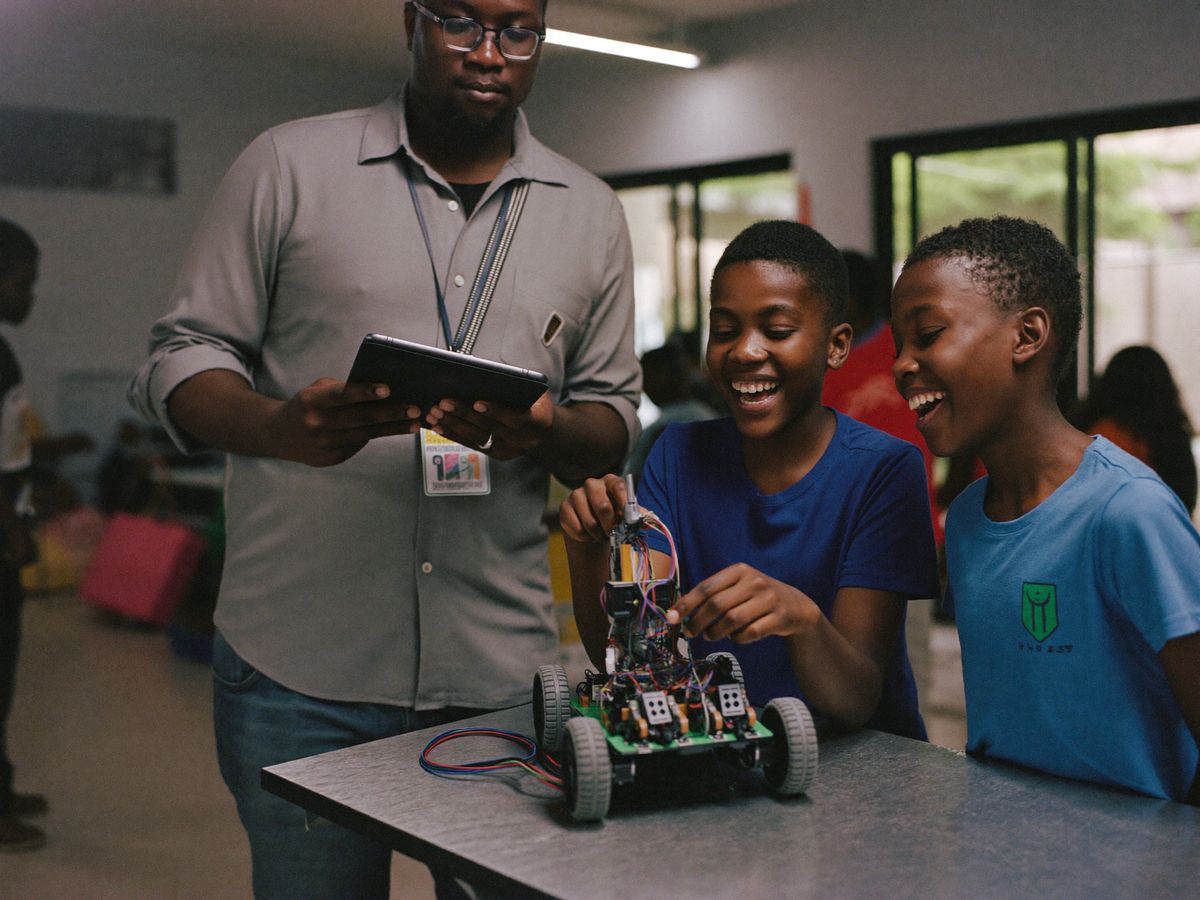
Rung three: they debug the logic before they ever meet a screen.
Safety and wellbeing
The rail, in detail.
A child learns how the machine works on them before it is handed to them.
- Safeguarding policy
- A written child-protection policy, vetted facilitators, a named safeguarding lead, and a reporting route every learner and guardian knows.
- Adult ratios
- No session runs above one trained adult for every eight learners, and never with a lone adult.
- Device access
- Devices are allow-listed and offline-first. Young learners get no open browser and no open camera. Access widens only with age and readiness.
- Data minimisation
- Journey pages use a first name and a code. Photographs and video are published only with guardian consent, and consent can be withdrawn.
- Digital wellbeing curriculum
- Screen-time literacy, what a machine can and cannot do, how a feed is designed to hold attention, and how to say no online, taught before advanced tools appear.
- Guardian involvement
- Guardians see the same journey page as sponsors, attend showcases, and sign off on builds and on every step up in device access.
We document every learner
A journey you can actually follow.
The point of BitByBit Africa is not a workshop that happened. It is a record of one child climbing, kept carefully, shared with the people who made it possible.
If it was not written down, it did not happen.
- On every journey page
- An intake baseline from real assessment, dated milestones for each rung, work samples in photo and short video with consent, facilitator notes, and a growing portfolio.
- What a sponsor receives
- Their learner's journey page, two milestone reports a year, the year-end portfolio, and the cohort's aggregate results.
- What we measure
- Reading fluency and comprehension, numeracy level, a computational-thinking rubric, a creativity and making rubric, projects completed, and progression to the next rung.
- How we report it
- Against each learner's own baseline and against the cohort, in plain language, once a term, with an audited financial statement once a year.
How to support
You are not funding a workshop. You are planting a seed in one named child.
Pick a learner. Support them term by term or year by year. Follow their climb from their first letter to their first working machine. The commitment is generational: a competent adult, or the innovator of their time, grown from one small, steady contribution.
Eight dollars a month. Eight years. One innovator.
One learner, fully covered: learning materials, a share of facilitator time, meals on session days, safeguarding, and documentation.
You receive a named journey page, two milestone reports a year, and the year-end portfolio.
One cohort of ten learners, plus the shared kit they climb on: unplugged coding sets, maker materials, and tools.
Quarterly cohort reports and a seat at the annual showcase.
A whole neighbourhood hub: facilitator stipends, a managed device set, robotics and AI kit, and full independent-style evaluation.
A named hub, board-level briefings, and a co-authored impact study.
Amounts are indicative. Before any funds are committed, BitByBit Africa publishes a full unit-cost breakdown per learner and per hub, and every year it publishes an audited statement.
The arithmetic of one innovator
About $96 a year. Eight years from pre-reading to AI-assisted building. Around $770 in total to grow one child into someone who can read the machine and build with it. One modest gift, once a month, held steady for the length of a school career.
Who this is for
Three ways in. One outcome.
Whichever door you come through, a named child is on the other side.
Angel investors
Back the earliest possible stage of human capital. Named beneficiaries, auditable reporting, clear milestones, and a model built from the start to be copied to the next community.
Organizations
Sponsor a cohort or a hub as your local education footprint. Co-branded reporting, showcase access, and a curriculum your teams can visit and volunteer in.
Individuals
One learner. One monthly gift. A relationship that lasts the whole climb, with real updates from a real child's progress.
We are starting this because the gap is specific and close to home. Children in our community are being offered the frontier before the foundation, and the tools before the guardrails. BitByBit Africa fixes the order. We build the reader, the estimator, the questioner, and the maker first, and only then the roboticist. We keep the receipts for every step, for every child.
If you support one learner, you will know their name, see their work, and watch them climb. That is the offer. It is small each month and large across a lifetime.
Kirsty Mueni, Founder / BitByBit Africa / hello@bitbybitafrica.org